Guide / Adoption
Can XRP replace nostro accounts? Follow the liquidity
A bridge asset may change where payment liquidity sits. It does not remove the need for local money, counterparties or a reliable route to the recipient.
Share this article
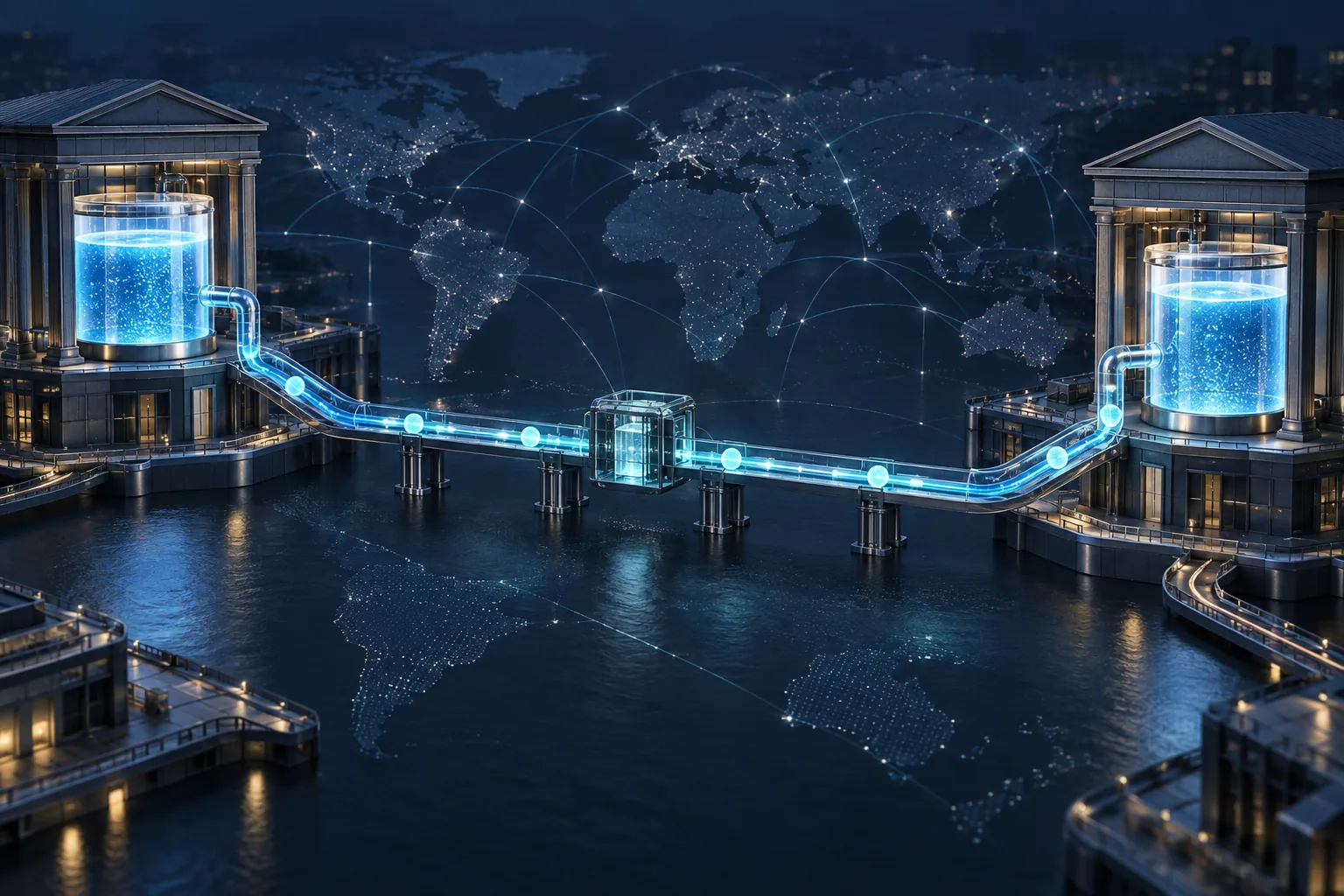
A bank serving customers across borders needs a way to make payments in places where it does not have its own banking operation. One established answer is to use another bank.
That arrangement can leave money spread across accounts and currencies so payments can be made when required. The economic question behind many blockchain payment proposals is whether the same service could be delivered with less money waiting in the wrong place.
Whose account is it?
The CPMI's 2016 report on correspondent banking explains relationships in which one bank provides services to another. A nostro account is “our account with you” from the customer bank's perspective. The same account is a vostro, “your account with us”, from the bank providing the account.
These are two viewpoints on an arrangement, not two separate piles of money. The report also examines costs and information-sharing problems. Its publication date is historical; it is not evidence of today's account balances or payment volumes.
Imagine a hypothetical bank holding foreign currency to meet customer payments. Keeping a buffer can make payments dependable, but that money has an opportunity cost. Reducing the buffer would be valuable only if the alternative remained dependable when customers needed it.
A bridge changes the funding question
A route using a bridge asset would exchange the sending asset into the bridge, move or exchange that value, then provide the receiving asset. XRP is one digital asset that can perform an intermediary role in suitable markets.
There is an existing example within the XRP Ledger's exchange: auto-bridging can route token trades through XRP when doing so improves the price. That network feature is not evidence that a particular bank has eliminated correspondent accounts.
The more ambitious banking claim needs a wider test. Who supplies the receiving currency? Can the transaction size be filled? What happens during a price move, a technical failure or a delay at the receiving institution?
Our introduction to XRP's economic role explains why available liquidity matters as much as a technically possible route.
Less prefunding is not no funding
As an economic inference, a payment still needs somebody able to deliver the destination asset. An alternative arrangement may move liquidity from a bank's standing balance to a dealer or another provider. That can be an improvement without making liquidity disappear.
The right comparison would measure the total cost and reliability of the complete service. It would include exchange spreads, access to local payment systems and the handling of exceptions.
The strongest case for a new route is therefore specific: a defined corridor, a defined customer need and evidence of better outcomes. “Replacing banking” is too broad to be a useful performance measure.
XRP for Newbies
Suppose you regularly buy supplies in another country. You could keep some money there ready to pay bills, or arrange to exchange and send money when each bill arrives.
The first method can be convenient but ties up cash. The second may use cash more efficiently, provided an exchange and payment service is available when you need it.
A nostro account is a bank's account at another bank, viewed from the account owner's side. Vostro describes the other bank's view of that same account.
XRP is a digital asset that may help connect suitable markets. The XRP Ledger is its public network; Ripple is a separate technology company.
The important question is who can deliver spendable money to the recipient. Changing the route can change the cost, but the recipient still needs to get paid.
Sources
- Correspondent banking ↗
BIS / Committee on Payments and Market Infrastructures · Accessed 2026-09-08
- Auto-Bridging ↗
XRPL.org · Accessed 2026-09-08
CONTINUE READING
Related articles
AnalysisAdoption
Could Companies Use XRP for Working Capital Between Countries?
XRP could shorten parts of a multinational funding cycle and reduce some idle foreign cash, but it cannot remove inventory, payroll or regulatory funding needs.

AnalysisAdoption
What Would Make Banks Hold XRP Instead of Simply Using XRPL?
Banks need a balance-sheet reason to hold XRP. Settlement inventory, market-making and collateral may qualify, but volatility, capital and compliance remain barriers.

AnalysisAdoption
Is the XRP Ledger Becoming an Institutional Blockchain? What the Data Shows
XRPL is carrying larger financial flows and more tokenised assets, but public-ledger data cannot by itself prove that banks or institutions control the activity.